Coordinate Notation for Translation Worksheet: Easy Math Practice
Coordinate notation for translation worksheet materials serve as essential practice tools for students learning to manipulate geometric figures within a Cartesian plane. These exercises translate abstract vector concepts into concrete coordinate movements, allowing learners to visualize how shapes shift without rotating or resizing. Mastery of this notation builds a foundational skill set applicable to higher-level mathematics and various scientific fields.
Understanding the Core Concept of Translation
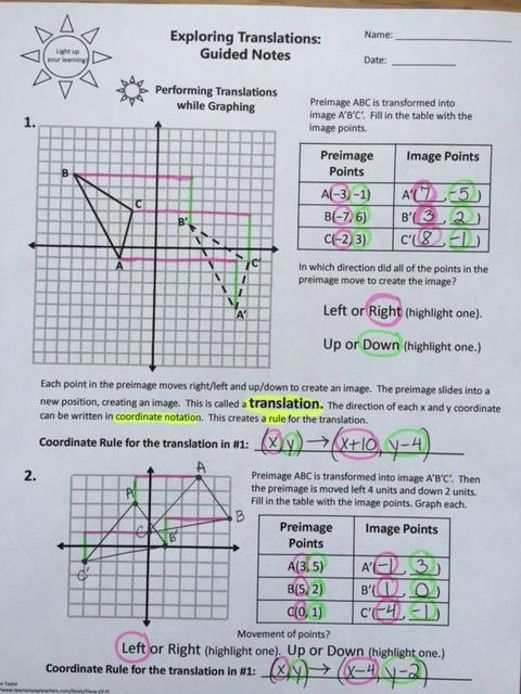
In geometry, a translation slides a figure from one position to another without altering its size, shape, or orientation. This rigid motion is defined by a vector that specifies the horizontal and vertical displacement. Representing this vector with ordered pairs, such as (x, y) → (x + a, y + b), provides a precise mathematical language for describing the movement. The coordinate notation for translation worksheet focuses on helping students internalize this transformation rule.
Breaking Down the Notation
The standard form of coordinate notation for a translation involves mapping an original point (x, y) to a new location (x', y'). The prime symbol (') denotes the image of the pre-image point. The values 'a' and 'b' represent the directed distances moved along the x-axis and y-axis, respectively. A positive 'a' indicates a shift to the right, while a negative 'a' indicates a shift to the left. Similarly, a positive 'b' signifies upward movement, and a negative 'b' signifies downward movement.


How a Worksheet Enhances Learning
A structured coordinate notation for translation worksheet typically begins with simple integer-based movements to build confidence. Learners practice plotting the original coordinates, applying the notation, and then graphing the resulting image. This repetitive process reinforces the connection between the algebraic rule and the visual outcome. By progressing to problems involving negative coordinates and fractional shifts, students develop a robust spatial understanding.
Practical Application and Problem Solving
Beyond rote calculation, high-quality worksheets present scenarios where students must determine the translation rule based on the coordinates of a figure and its image. This reverse engineering requires analytical thinking and a deep grasp of the notation. Students examine the change in the x-coordinates to find 'a' and the change in the y-coordinates to find 'b'. This skill is vital for understanding vectors in physics and computer graphics.


Visualizing the Process on the Coordinate Plane
Graphing remains a critical component of these exercises. Students use the notation to calculate new vertices and then draw the translated figure on the coordinate plane. This visual confirmation helps solidify the concept that every point of the shape moves identically. The worksheet provides a structured space for this practice, ensuring that learners can accurately represent the transformation geometrically.
Complexities and Advanced Practice
As proficiency grows, worksheets introduce more complex problems involving composite transformations, where a translation follows a rotation or reflection. Here, the coordinate notation becomes even more powerful, allowing students to chain operations mathematically. Advanced problems may require applying multiple rules sequentially, testing the student's ability to manage layered geometric instructions effectively.
Benefits of Regular Practice
Consistent work with a coordinate notation for translation worksheet develops precision in algebraic manipulation and enhances geometric intuition. Students become adept at moving between graphical and symbolic representations, a critical skill in STEM education. This practice ultimately prepares them for more abstract vector mathematics and ensures they can confidently navigate spatial problems in real-world contexts.




Related Articles

Year 3 Four Operations Worksheet: Fun Math Practice
Mastering the four operations worksheet year 3 serves as the critical bridge between basic numeracy and complex mathematical reasoning. At this stage, children...

Algebra 1 Unit 8 Factoring by GCF Worksheet Answer Key – Easy Practice & Solutions
Mastering the foundational skills of algebra requires consistent practice, especially when it comes to identifying common structures within mathematical...

Free Printable Probability Coloring Worksheets – Fun Math Practice For Kids
Probability coloring worksheet free printable resources represent a dynamic intersection of mathematics education and creative expression, offering students an...

Colorful Division Facts Printables: Fun & Easy Math Practice
Mastering basic arithmetic is the cornerstone of mathematical confidence, and division facts are the essential building blocks of that foundation. For parents...

Free Printable Addition & Subtraction with Regrouping Color Sheets – Fun Math Practice for Kids
Mastering arithmetic is a fundamental milestone in a young student's educational journey, and subtraction with regrouping often represents a significant...

Skin Worksheet Master: Anatomy Labeling Guide for Easy Learning
For anyone studying human biology or pursuing a career in healthcare, a dedicated skin worksheet for anatomy serves as an indispensable tool. This specific...