Mastering Mitosis: Sequencing Worksheet Answers & Study Guide
Navigating the intricate stages of cellular division often requires structured practice, and a mitosis sequencing worksheet serves as an essential tool for biology students. These worksheets challenge learners to identify and order the distinct phases—prophase, metaphase, anaphase, and telophase—along with the critical events of cytokinesis. Mastering the sequence is fundamental to understanding how a single cell duplicates its genetic material and divides into two genetically identical daughter cells, a cornerstone concept in life science.
Deconstructing the Stages for Accurate Sequencing
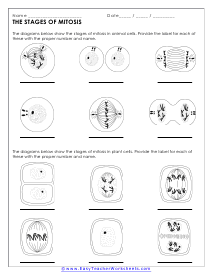
A typical mitosis sequencing worksheet presents a series of unordered descriptions or diagrams that students must analyze. The key to success lies in recognizing the defining characteristics of each phase. For instance, prophase is marked by chromatin condensing into visible chromosomes and the nuclear envelope breaking down, while metaphase is identified by the alignment of chromosomes at the cell's equatorial plate. Understanding these specific visual and textual cues is paramount for placing the stages in the correct chronological order, transforming a random list into a logical narrative of cellular reproduction.
Visual Cues and Chromosomal Behavior
Many advanced worksheets incorporate photomicrographs or detailed illustrations, requiring students to match images to their corresponding phase names. In these scenarios, the focus shifts to interpreting chromosomal behavior. During anaphase, the sister chromatids are pulled apart toward opposite poles of the cell, a stark contrast to the aligned chromosomes of metaphase. A well-designed worksheet will highlight these dynamic changes, reinforcing the concept that the sequence is not arbitrary but reflects a precise, energy-driven mechanical process essential for genetic stability.


The Role of Cytokinesis in the Sequence
It is crucial to distinguish between mitosis—the division of the nucleus—and cytokinesis, the division of the cytoplasm. While some worksheets treat cytokinesis as a separate section, it is most accurate to conceptualize it as the final physical step that completes the process. Typically, cytokinesis begins during late anaphase or telophase and concludes after telophase, resulting in two separate cells. A comprehensive answer key will clarify this overlap, ensuring students grasp that the "sequencing" extends to the completion of the entire cell division cycle.
Deciphering Answer Keys and Common Pitfalls
When verifying mitosis sequencing worksheet answers, learners should be aware of common misconceptions. A frequent error is confusing the events of anaphase (sister chromatids separating) with those of telophase (nuclear envelopes reforming around the separated sets). Detailed answer keys often include brief explanations for why a particular order is correct, such as stating that chromosomes must decondense before the nucleolus can reappear. Engaging with these explanations transforms a simple check of answers into a deeper learning opportunity that solidifies the material.


Applying the Sequence to Real-World Concepts
Beyond rote memorization, the ability to sequence mitosis is critical for understanding broader biological principles. For example, errors in this sequence can lead to serious conditions like cancer, where cell division becomes unregulated. A robust worksheet connects the theoretical sequence to these practical implications, encouraging students to see the phases not as isolated steps but as part of a vital, real-world process. This contextual understanding is what moves learning from passive recall to active comprehension.
Utilizing Digital Resources and Interactive Tools
The modern landscape of educational resources offers dynamic alternatives to static paper worksheets. Interactive online modules often provide instant feedback for mitosis sequencing worksheet answers, allowing students to immediately correct mistakes and replay the process. These digital tools frequently include drag-and-drop interfaces for ordering phases or timed challenges that reinforce speed and accuracy. Leveraging these technologies caters to different learning styles and provides a more engaging, self-paced environment for mastering this fundamental biological sequence.
Maximizing Educational Value Through Practice
Ultimately, the value of a mitosis sequencing worksheet is realized through deliberate practice and reflection. Students should not merely seek the final list of answers but should use the exercise to identify their own weaknesses in visual interpretation or phase recognition. By consistently working through these sequences and reviewing the provided answers with a critical eye, learners build a durable mental framework for cell division. This disciplined approach ensures that the complex choreography of mitosis becomes an intuitive and well-understood component of their scientific knowledge.


Related Articles

Master Eclipse Web Research: Worksheet Answers & Study Guide
Navigating the complexities of astronomical events often requires structured analysis, and an eclipse web research worksheet serves as a critical tool for...

Master Mass Spectroscopy: Worksheet Answers & Study Guide
Navigating the complexities of analytical chemistry often requires specific tools to interpret data accurately, and mass spectroscopy is a prime example where...

Realidades 2 Capítulo 4A Organizer Answers: Complete Study Guide
Navigating the intricacies of Spanish language learning often requires specific resources to stay on track, especially when using structured textbooks like...

Cell Division Reinforcement Answers: Mastering Mitosis & Meiosis
Cell division reinforcement answers represent a critical intersection of molecular biology and genetic stability, addressing how organisms ensure the precise...

Honors Geometry Chapter 8 Review Answers: Key Solutions & Study Guide
Securing a strong foundation in high school mathematics often hinges on mastering the principles of geometry, and Honors Geometry Chapter 8 serves as a...

The Cell Coloring Worksheet Answers: A Colorful Guide to Cell Structures
Navigating the complexities of cellular biology often requires structured practice, and the cell coloring worksheet answers serve as a vital tool for students...